
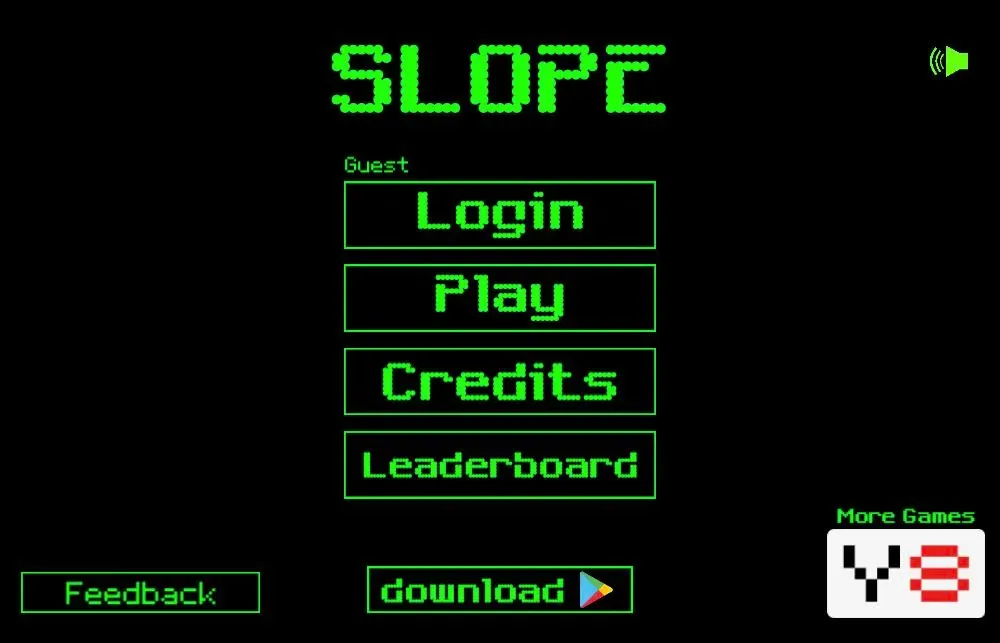
This page is written for two readers: someone opening Slope for the first time who needs the controls and a sense of what a decent score looks like, and a returning player trying to climb the leaderboard. It covers the original Slope, the 2014 Y8 release playable above. Slope 2, Slope 3 and Slope Run are separate games with their own tracks and their own boards, and nothing here describes them.
Key takeaways
- Slope has exactly two inputs: steer left and steer right. The ball accelerates on its own, and nothing you press will slow it down.
- The game accepts three key pairs, not two. Arrow keys, A/D, and Q/D all steer, which the on-screen tutorial states directly.
- We read the game's own Y8 leaderboard on August 17, 2026. A score of 68 was enough for the global top ten that week, 90 for the month, and 245 for the all-time top ten.
- The Credits screen inside the game names
@RobKaySras its maker,@SynthRfor the music, and Y8.com as publisher, with a 2014 copyright line. - Slope is a Unity WebGL build, not Flash, which is why it still runs in every modern browser.
How to play Slope
Press Play on the menu and the ball starts rolling immediately. There is no countdown, so put your fingers on the keys before you click.
- Steer with the left and right arrow keys, with A and D, or with Q and D. The game's tutorial line names all three pairs.
- Keep the ball on the green track. Falling off either edge ends the run.
- Weave around the raised blocks that rise out of the track surface.
- Cross the gaps where the track breaks apart by lining the ball up before you reach them.
- Survive. Your score climbs with distance, and the run continues until you fall or crash.
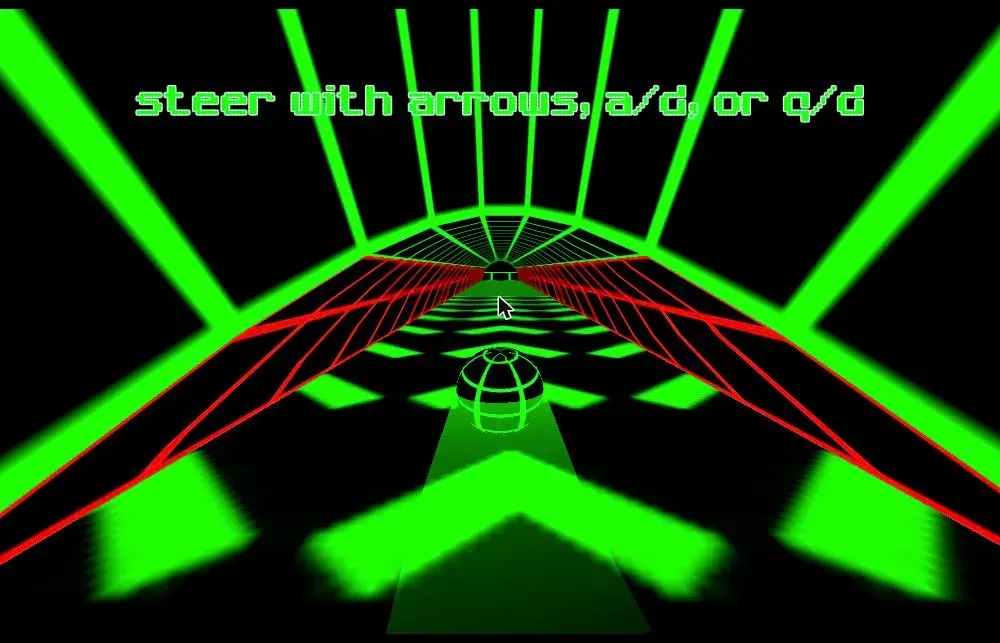
That instruction line is the game's own, captured on August 17, 2026. Every competing Slope page we checked lists arrows and A/D only. Q/D is in the build, and it matters if you sit at an AZERTY keyboard where A and D are nowhere near each other.
Controls at a glance
| Action | Keys |
|---|---|
| Steer left | Left Arrow, A, or Q |
| Steer right | Right Arrow or D |
| Slow down | Not available |
| Jump | Not available |
| Pause | Not available |
The three missing rows are the point. Slope gives you lateral steering and nothing else. Players search for a way to slow the ball down, and the honest answer is that no such control exists. Acceleration is automatic and one-directional, so the only way to buy yourself time is to steer less, not to brake.
What counts as a good Slope score
A good Slope score depends on which board you are measuring against. On August 17, 2026, the tenth-place score was 68 on the 7-day board, 90 on the 30-day board, and 245 on the all-time board, with the all-time record standing at 305.
This is the question the game's audience asks most, in a dozen phrasings, and it is usually answered with numbers nobody can check. So we opened the game's own High Scores panel on August 17, 2026 and wrote down what it showed.
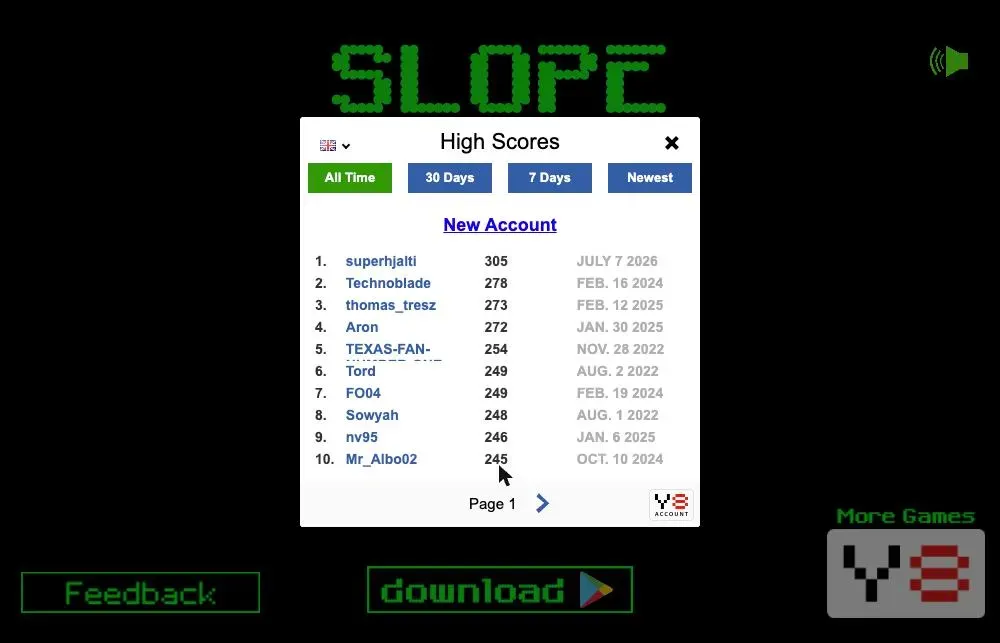
| Board | Top score | 10th place | What 10th place means |
|---|---|---|---|
| All time | 305 | 245 | The lifetime benchmark |
| Last 30 days | 218 | 90 | A strong month |
| Last 7 days | 218 | 68 | A strong week |
The all-time board read 305, 278, 273, 272, 254, 249, 249, 248, 246 and 245. The 30-day board ran 218 down to 90. The 7-day board ran 218 down to 68.
Read those three rows together and the difficulty curve of Slope becomes concrete. We call the result the Slope score ladder, and it has four rungs:
- Rung 1, under 20. Where most first sessions end. The speed ramp catches new players before the first real gap.
- Rung 2, 50 to 70. Weekly leaderboard territory. A realistic target for an afternoon of practice.
- Rung 3, 90 to 120. A good month's work, and enough for the 30-day board.
- Rung 4, above 245. All-time company. Only ten scores in the game's recorded history sit there.
One caveat worth stating plainly: this is the leaderboard that ships with this build of the game, and posting a score to it requires a free Y8 account. Playing does not. Higher numbers circulate on video sites and on other Slope pages, including a widely repeated claim of 417. We found no board, replay, or record that substantiates any of them, so we are quoting the one scoreboard we can actually read.
How we tested
All of the above comes from one sitting on August 17, 2026, with the game reloaded repeatedly at a 1000 by 820 pixel window and once more at 430 pixels to check the small-screen behavior. Two things got in our way, and both are worth reporting rather than hiding.
Runs left alone end almost immediately. Every attempt we started and did not actively steer was over in roughly a second. That is a fair description of the game's difficulty, and it is also why this page has no screenshot of a score climbing mid-run.
The game-over screen hides the score. When a run ends, the camera settles at a fixed angle that puts the Menu, Leaderboard and AGAIN buttons in front of the readout. So the numbers on this page come from the leaderboard panel, which we can read cleanly, rather than from our own attempts.
Five habits that push your score higher
These come from watching how runs end rather than from a generic tip list.
Tap, do not hold. Holding a steering key builds lateral momentum that keeps carrying the ball after you let go. Short taps put you where you meant to be. Oversteering into empty space is the single most common way a promising run dies.
Look at the horizon, not at the ball. The ball is already where it is. The useful information is forty meters ahead, where the track narrows or splits. Players who watch their own ball react to obstacles roughly a second too late.
Live in the middle lane. Center is not the fastest line, it is the most forgiving one. From the middle you can correct in either direction. From the edge you can only correct one way, and the other option is the drop.
Accept that the speed is not negotiable. There is no brake. Once you internalize that the ball will keep getting faster no matter what you do, you stop making panicked inputs and start making early ones.
Restart fast and often. A Slope run is short. The menu has an AGAIN button right on the game-over screen for exactly this reason. Reading the track is a skill built from repetitions, not from long single attempts.
What actually ends a run
Two things end a Slope run, and neither of them is a timer.
You leave the track. The playing surface is a narrow green ribbon suspended in black space, with the edges and the far barriers picked out in red. Step off either side and you fall.
You hit something on the surface. Raised blocks rise out of the track itself, and at speed they arrive with very little warning.
Both risks scale with the same variable: velocity. The track layout is generated as you descend, so no two runs present the same sequence, and there is no memorizable pattern to learn. What improves is your reaction window, not your route knowledge.
Who made Slope, and when
Slope's Credits screen answers this without any guesswork required. Opened on August 17, 2026, it reads:
game by @RobKaySrmusic by @SynthRpublished by @Y8.com2014, Y8.com, All Rights Reserved
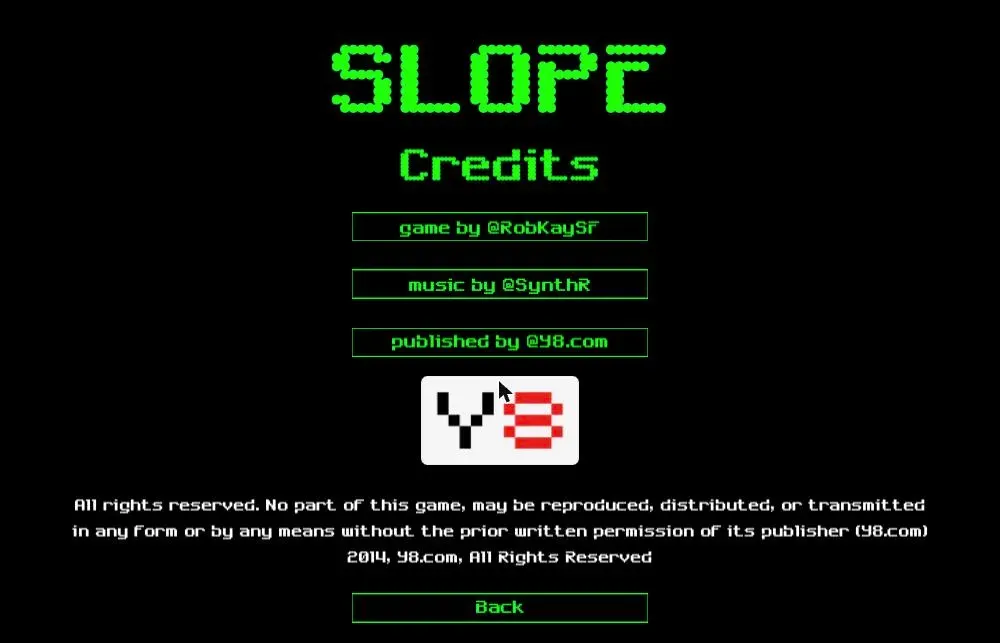
So the game is a 2014 release published by Y8, and it has been running continuously for more than a decade.
We are deliberately not repeating the claim, common across other Slope pages, that the game was made by the designer behind Guitar Hero. The Credits screen names a Y8 handle. Nothing in the game connects that handle to that career, and we found no source that does. If it is ever documented, we will update this section.
The build itself is Unity WebGL. That detail settles a question players still ask: Slope is not a Flash game and never depended on the Flash plugin, which is why it kept working after browsers dropped Flash support at the end of 2020.
Playing Slope on a school Chromebook or a locked network
A large share of Slope's audience is looking for it from a school or office network, which is why "slope unblocked" is one of the most common ways people search for this game.
Here is what we can say honestly. Slope on this page needs a browser and nothing else. There is no download, no installer, no browser extension, and no sign-up before you play. It runs on a Chromebook exactly as it runs on a desktop, because Unity WebGL is a standard web technology rather than an app.
What we cannot promise is that a specific network will allow it. Whether this page loads on a managed school Chromebook depends on that school's filtering policy, not on the game. Any site claiming to guarantee access through a network it has never seen is guessing.
One practical note on devices: we tested this build at a 430-pixel viewport width on August 17, 2026. The menu scales down cleanly, but the in-game tutorial still names keyboard keys only and no on-screen steering buttons appear. Treat Slope as a keyboard game. On a phone or tablet without a physical keyboard, expect a poor experience.
Start your run
Press Play above, put a finger on each arrow key, and give yourself ten short attempts before you judge your score. Sixty-eight points was a global top-ten week when we measured it. That number is closer than it looks.